Publications
For a full publications list with citation counts, please see my Google Scholar page.
Publications
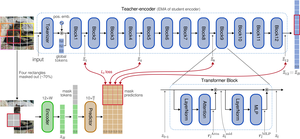
Self-Distillation of Hidden Layers for Masked Self-Supervised Representation Learning
Scott C. Lowe, Anthony Fuller, Sageev Oore, Evan Shelhamer, Graham W. Taylor
Advances in Neural Information Processing Systems 40 (NeurIPS 2026)
Bootleg is a self-supervised image pretraining method that predicts a teacher network's multiple hidden layers at once, capturing features across abstraction levels and beating comparable baselines on classification and segmentation.
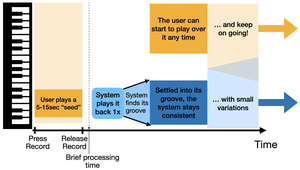
SmartLooper: a Framework for Personalized Human-AI Musical Improvisation
Finlay Miller*, Sageev Oore*, Chandramouli Shama Sastry, Marvin F. da Silva, Sri Harsha Dumpala, Daniel Oore, Scott C. Lowe
The 27th International Society for Music Information Retrieval Conference (ISMIR 2026)
SmartLooper is a real-time piano improvisation system that builds an evolving accompaniment by walking through a performer's own recorded loops in embedding space, so they effectively duet with themselves.
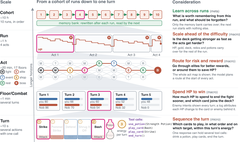
SpireBench: Evaluating Long-Horizon Strategic Play of Agentic Models with Slay the Spire
Scott C. Lowe, Sander W. Keemink
arXiv preprint arXiv:2610.12596 preprint
On strategy game Slay the Spire, frontier agentic LLMs perform comparably to average humans, but trail significantly behind expert players. They are unable to consolidate memories or learn strategies from in-context information to improve their performance.
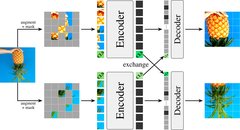
Masked Swingers: Harnessing Data Augmentation to Advance Autoencoders for Self-Supervised Learning
Anthony Fuller, Scott C. Lowe, Daniel G. Kyrollos, Graham W. Taylor†, Evan Shelhamer†, James R. Green†
arXiv preprint arXiv:2609.38278 preprint
We swap the CLS tokens between two views of the same image, encouraging the model to learn a view-agnostic summary of the image.
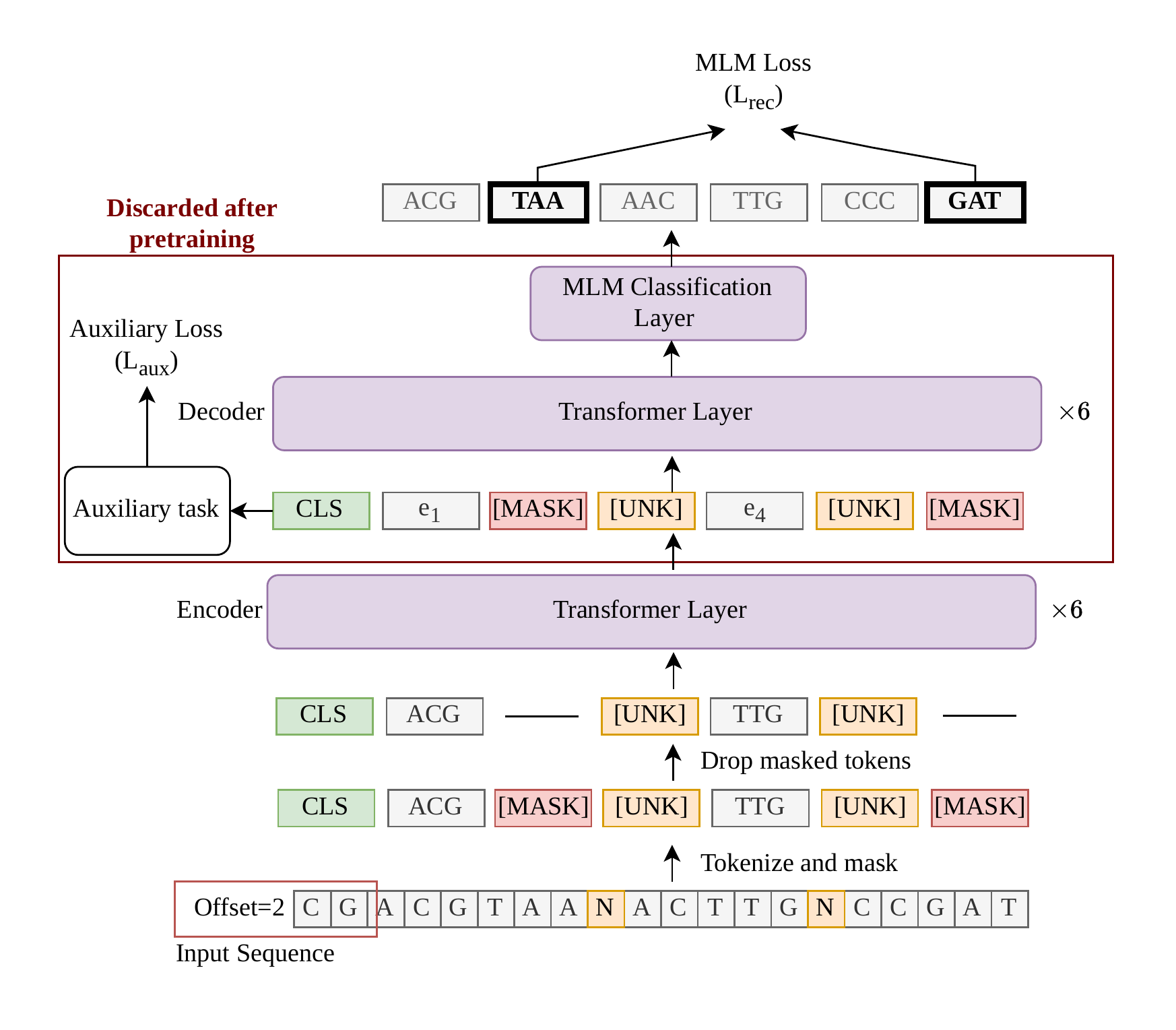
BarcodeMAE+: Rethinking Masked Pretraining and Global Representations for DNA Barcode Foundation Models
Monireh Safari*, Pablo Millan Arias*, Scott C. Lowe, Lila Kari, Angel X. Chang, Graham W. Taylor
arXiv preprint arXiv:2609.35877 preprint
BarcodeMAE+ redesigns DNA foundation models with an encoder-decoder that hides masking tokens from the encoder, and combines this with a supervised pretraining objective to learn whole-barcode CLS tokens useful for downstream tasks.
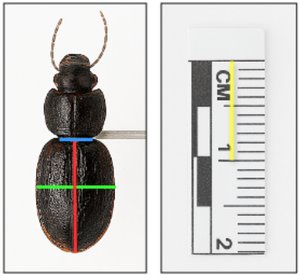
A continental-scale dataset of ground beetles with high-resolution images and validated morphological trait measurements
S. M. Rayeed*, Mridul Khurana*, Alyson East*, Isadora E. Fluck, Elizabeth G. Campolongo, Samuel Stevens, Iuliia Zarubiieva, Scott C. Lowe, Michael W. Denslow, Evan D. Donoso, Jiaman Wu, Michelle Ramirez, Benjamin Baiser, Charles V. Stewart, Paula Mabee, Tanya Berger-Wolf, Anuj Karpatne, Hilmar Lapp, Robert P. Guralnick, Graham W. Taylor†, Sydne Record†
Scientific Data, (2026)
A dataset of over 13,200 North American ground beetle specimens with high-resolution images and sub-millimeter-accurate elytra measurements, supporting automated trait extraction and species identification.
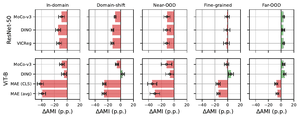
An Empirical Study into Clustering of Unseen Datasets with Self-Supervised Encoders
Scott C. Lowe*, Joakim Bruslund Haurum*, Sageev Oore†, Thomas B. Moeslund†, Graham W. Taylor†
Transactions on Machine Learning Research
Shows that image encoders trained without labels can group entirely new, unseen datasets into meaningful clusters without retraining, and that cluster quality can be judged without ground-truth labels.
Hidden-Layer Self-Distillation Yields Drift-Resilient Visual Representations
Scott C. Lowe, Anthony Fuller, Sageev Oore, Graham W. Taylor, Evan Shelhamer
Catch, Adapt, and Operate: Monitoring ML Models Under Drift Workshop, ICLR 2026
Shows that Bootleg, self-supervised pretraining that predicts a teacher's multiple hidden layers, yields visual representations that resist distribution shift better than MAE and I-JEPA and adapt well at test time.
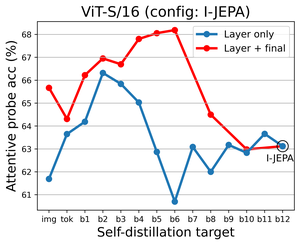
Bridging Generative and Predictive Paradigms via Hidden-Self-Distillation
Scott C. Lowe, Anthony Fuller, Sageev Oore, Evan Shelhamer, Graham W. Taylor
Multimodal Intelligence: Next Token Prediction & Beyond Workshop, ICLR 2026
Frames Bootleg, which predicts a teacher's multiple hidden layers, as a bridge between generative pixel-reconstruction and predictive embedding-prediction in self-supervised learning, capturing the strengths of both.

Understanding and Improving Shampoo and SOAP via Kullback-Leibler Minimization
Wu Lin, Scott C. Lowe, Felix Dangel, Runa Eschenhagen, Zikun Xu, Roger B. Grosse
The Fourteenth International Conference on Learning Representations (ICLR 2026)
Reinterprets the Shampoo and SOAP neural-network optimizers through Kullback-Leibler minimization, yielding KL-Shampoo, which trains language models faster and more accurately without Adam's extra memory cost.
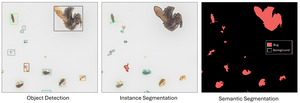
A multi-modal dataset for insect biodiversity with imagery and DNA at the trap and individual level
Johanna Orsholm*, John Quinto*, Hannu Autto, Gaia Banelyte, Nicolas Chazot, Jeremy deWaard, Stephanie deWaard, Arielle Farrell, Brendan Furneaux, Bess Hardwick, Nao Ito, Amlan Kar, Oula Kalttopää, Deirdre Kerdraon, Erik Kristensen, Jaclyn McKeown, Tommi Mononen, Ellen Nein, Hanna Rogers, Tomas Roslin, Paula Schmitz, Jayme Sones, Maija Sujala, Amy Thompson, Evgeny V. Zakharov, Iuliia Zarubiieva, Akshita Gupta, Scott C. Lowe, Graham W. Taylor
Scientific Data 13, 630, (2026)
MassID45 is a dataset of bulk insect-trap samples combining photographs and DNA barcodes, with segmentation masks and species labels for over 17,000 individual specimens.
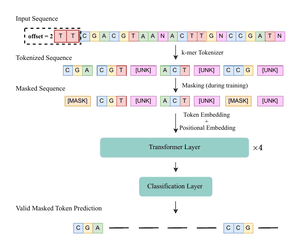
BarcodeBERT: Transformers for Biodiversity Analysis
Pablo Millan Arias*, Niousha Sadjadi*, Monireh Safari*, ZeMing Gong, Austin T. Wang, Joakim Bruslund Haurum, Iuliia Zarubiieva, Dirk Steinke, Lila Kari, Angel X. Chang, Scott C. Lowe†, Graham W. Taylor†
Bioinformatics Advances, 6(1), vbag054, 2026
BarcodeBERT is a transformer trained on 1.5 million invertebrate DNA barcodes that identifies insect species from short genetic sequences, matching the standard BLAST tool's accuracy while running 55 times faster.
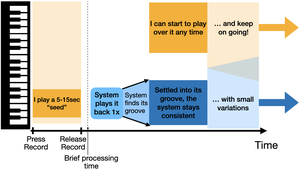
A Loopy Framework and Tool for Real-time Human-AI Music Collaboration
Sageev Oore*, Finlay Miller*, Chandramouli Shama Sastry, Sri Harsha Dumpala, Marvin F. da Silva, Daniel Oore, Scott C. Lowe
Artificial Intelligence for Music: Where Creativity Meets Computation Workshop, NeurIPS 2025
Argues that looping is an effective framework for real-time human-AI music collaboration, and introduces SmartLooper, which improvises by stochastically traversing a musician's own recorded fragments in a learned embedding space.
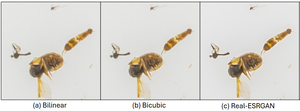
BugSR: Improving Tiny Instance Segmentation on the MassID45 Dataset
John Quinto, Scott C. Lowe, Akshita Gupta, Johanna Orsholm, Prajakta Darade, Iuliia Zarubiieva, Brendan Furneaux, Tommi Mononen, Tomas Roslin, Graham W. Taylor
Imageomics: Discovering Biological Knowledge from Images Using AI Workshop, NeurIPS 2025
Super-resolution preprocessing improves segmentation of thousands of tiny, densely packed insects in bulk trap images, raising average precision by 9.3 points on the MassID45 dataset, but most gains can be attained simply with bicubic interpolation.
BarcodeMamba+: Advancing State-Space Models for Fungal Biodiversity Research
Tiancheng Gao, Scott C. Lowe, Brendan Furneaux, Angel X. Chang, Graham W. Taylor
Imageomics: Discovering Biological Knowledge from Images Using AI Workshop, NeurIPS 2025
BarcodeMamba+ is an efficient state-space foundation model that classifies fungi from DNA barcodes, learning from mostly-unlabelled data to outperform supervised methods across all taxonomic levels.
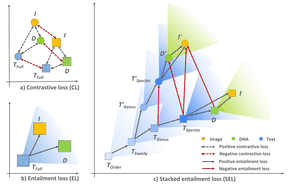
Hyperbolic Multimodal Representation Learning for Biological Taxonomies
ZeMing Gong, Chuanqi Tang, Xiaoliang Huo, Nicholas Pellegrino, Austin Wang, Graham W. Taylor, Angel X. Chang, Scott C. Lowe†, Joakim Bruslund Haurum†
2nd Beyond Euclidean Workshop: Hyperbolic and Hyperspherical Learning for Computer Vision Workshop, ICCV 2025
Embeds specimen images, DNA barcodes, and taxonomic labels into a shared hyperbolic space that mirrors biological hierarchies, improving species classification and retrieval especially at higher taxonomic ranks.
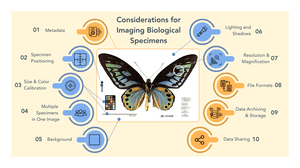
Optimizing Image Capture for Computer Vision-Powered Taxonomic Identification and Trait Recognition of Biodiversity Specimens
Alyson East, Elizabeth G. Campolongo, Luke Meyers, S.M. Rayeed, Samuel Stevens, Iuliia Zarubiieva, Isadora E. Fluck, Jennifer C. Girón, Maximiliane Jousse, Scott Lowe, Kayla I. Perry, Isabelle Betancourt, Noah Charney, Evan Donoso, Nathan Fox, Kim J. Landsbergen, Ekaterina Nepovinnykh, Michelle Ramirez, Parkash Singh, Khum Thapa-Magar, Matthew Thompson, Evan Waite, Tanya Berger-Wolf, Hilmar Lapp, Paula Mabee, Graham Taylor, Sydne Record
Methods in Ecology and Evolution, 00, 1–16, 2025
Provides practical guidelines for photographing museum biodiversity specimens so that computer vision tools can more reliably identify species and measure traits from the resulting images.
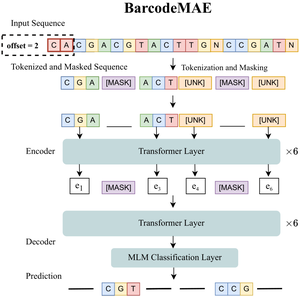
Enhancing DNA Foundation Models to Address Masking Inefficiencies
Monireh Safari*, Pablo Millan Arias*, Scott C. Lowe, Lila Kari, Angel X. Chang, Graham W. Taylor
Artificial Intelligence for Nucleic Acids (AI4NA) Workshop, ICLR 2025
BarcodeMAE redesigns DNA foundation models with an encoder-decoder that hides masking tokens from the encoder, yielding sharper DNA-barcode features and over ten points better species classification.
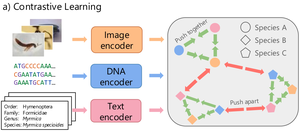
CLIBD: Bridging Vision and Genomics for Biodiversity Monitoring at Scale
ZeMing Gong, Austin T. Wang, Xiaoliang Huo, Joakim Bruslund Haurum, Scott C. Lowe, Graham W. Taylor, Angel X. Chang
The Thirteenth International Conference on Learning Representations (ICLR 2025)
CLIBD aligns insect photographs, DNA barcodes, and taxonomic labels in one shared space, letting it classify both known and unknown species without fine-tuning and beating single-source methods.
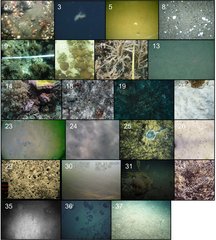
BenthicNet: A global compilation of seafloor images for deep learning applications
Scott C. Lowe*, Benjamin Misiuk*, Isaac Xu*, Shakhboz Abdulazizov, Amit R. Baroi, Alex C. Bastos, Merlin Best, Vicki Ferrini, Ariell Friedman, Deborah Hart, Ove Hoegh-Guldberg, Daniel Ierodiaconou, Julia Mackin-McLaughlin, Kathryn Markey, Pedro S. Menandro, Jacquomo Monk, Shreya Nemani, John O'Brien, Elizabeth Oh, Luba Y. Reshitnyk, Katleen Robert, Chris M. Roelfsema, Jessica A. Sameoto, Alexandre C.G. Schimel, Jordan A. Thomson, Brittany R. Wilson, Melisa C. Wong, Craig J. Brown†, Thomas Trappenberg†
Scientific Data 12, 230, (2025)
BenthicNet is a globally diverse collection of 1.3 million curated seafloor images with 3.1 million habitat annotations, enabling deep learning models that automate the analysis of benthic imagery.
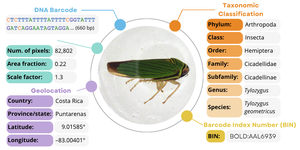
BIOSCAN-5M: A Multimodal Dataset for Insect Biodiversity
Zahra Gharaee*, Scott C. Lowe*, ZeMing Gong*, Pablo Millan Arias*, Nicholas Pellegrino, Austin T. Wang, Joakim Bruslund Haurum, Iuliia Zarubiieva, Lila Kari, Dirk Steinke†, Graham W. Taylor†, Paul Fieguth†, Angel X. Chang†
Advances in Neural Information Processing Systems 37 (NeurIPS 2024)
BIOSCAN-5M is a dataset of over five million insect specimens pairing images, DNA barcodes, taxonomic labels, and geographic and size information to advance automated biodiversity monitoring.
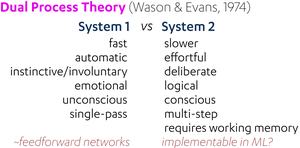
System 2 Reasoning Capabilities Are Nigh
Scott C. Lowe
The First Workshop on System-2 Reasoning at Scale, NeurIPS 2024
Reviews progress toward machine reasoning and argues that today's models fall just short of deliberate, human-like System 2 thought, with only a few remaining hurdles before achieving it.
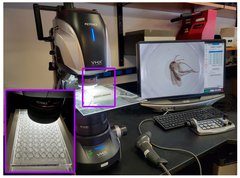
Towards a Taxonomy Machine: A Training Set of 5.6 Million Arthropod Images
Dirk Steinke, Sujeevan Ratnasingham, Jireh Agda, Hamzah Ait Boutou, Isaiah C.H. Box, Mary Boyle, Dean Chan, Corey Feng, Scott C. Lowe, Jaclyn T.A. McKeown, Joschka McLeod, Alan Sanchez, Ian Smith, Spencer Walker, Catherine Y.-Y. Wei, Paul D.N. Hebert
Data 9 (11), 122, 2024
A dataset of 5.6 million high-resolution microscope images spanning 324,000 arthropod species from 48 countries, built for training machine learning models to identify specimens taxonomically.
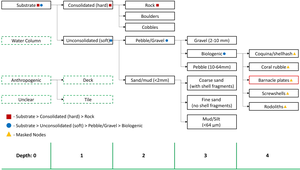
Hierarchical multi-label classification with missing information for benthic habitat imagery
Isaac Xu, Benjamin Misiuk, Scott C. Lowe, Martin Gillis, Thomas Trappenberg, Craig J. Brown
2024 International Joint Conference on Neural Networks (IJCNN), 1–10, 2024
Shows how to classify seafloor habitat photos into layered category hierarchies despite patchy, inconsistent labels, finding that self-supervised pretraining on ocean imagery beats generic pretraining.
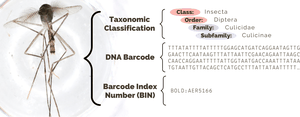
A step towards worldwide biodiversity assessment: The BIOSCAN-1M insect dataset
Zahra Gharaee*, ZeMing Gong*, Nicholas Pellegrino*, Iuliia Zarubiieva, Joakim Bruslund Haurum, Scott C. Lowe, Jaclyn T.A. McKeown, Chris C.Y. Ho, Joschka McLeod, Yi-Yun C. Wei, Jireh Agda, Sujeevan Ratnasingham, Dirk Steinke†, Angel X. Chang†, Graham W. Taylor†, Paul Fieguth†
Advances in Neural Information Processing Systems 36 (NeurIPS 2023)
BIOSCAN-1M is a dataset of over a million expert-labelled insect images paired with DNA barcodes, built to train computer-vision models that classify species and help catalogue global biodiversity.
Prevention of obstructive apnea events with machine learning
Hamed Hanafi, Julia Paffile, Meagan Sinclair, Kamal El-Sankary, Scott Lowe, Sageev Oore, Stephen Driscoll, Thomas Penzel, Ingo Fietze, Sanjay Patel, Reena Mehra, Debra Morrison
European Respiratory Journal 62 (suppl 67), 2023
Uses a machine-learning algorithm that predicts apnea events seconds ahead to trigger preemptive pressure boosts on PAP machines, significantly reducing the apnea-hypopnea index without disturbing sleep quality in eleven patients.
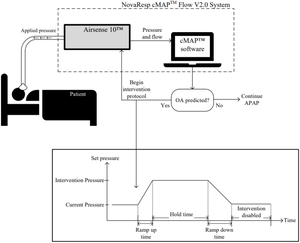
The Beginning of the AI-Enabled Preventative PAP Therapy Era: A First-in-Human Proof of Concept Interventional Study
Meagan Sinclair, Hamed Hanafi Alamdari, Julia Paffile, Kamal El-Sankary, Scott C. Lowe, Stephen Driscoll, Sageev Oore, Heather Tomson, Gregory Begin, Guillermo Aristi, Michael Schmidt, David Roach, Thomas Penzel, Ingo Fietze, Sanjay R. Patel, Reena Mehra, Debra Morrison
IEEE Transactions on Biomedical Engineering 70 (10), 2776–2787, 2023
A first-in-human trial where machine learning predicts apneas from a PAP device's own airflow and pressure sensors and preemptively adjusts pressure, cutting the apnea-hypopnea index by 31.6% while preserving sleep quality.
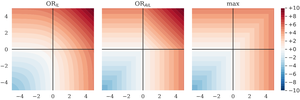
Logical Activation Functions: Logit-space equivalents of Boolean Operators
Scott C. Lowe, Robert Earle, Jason d'Eon, Thomas Trappenberg, Sageev Oore
Advances in Neural Information Processing Systems 35 (NeurIPS 2022)
Introduces neural network activation functions that perform Boolean logic (AND, OR, XNOR) on feature probabilities, improving accuracy on image classification, transfer learning, and reasoning tasks.
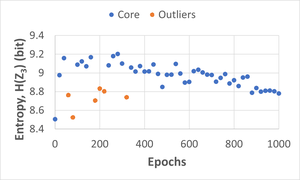
Label-free Monitoring of Self-Supervised Learning Progress
Isaac Xu, Scott C. Lowe, Thomas Trappenberg
IEEE Canadian Conference on Electrical and Computer Engineering (CCECE), 2022
Shows that clustering metrics like silhouette score can track a self-supervised vision model's training progress without any labelled data, though reliability varies by method.
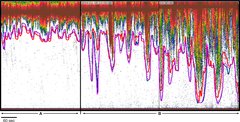
Echofilter: A Deep Learning Segmention Model Improves the Automation, Standardization, and Timeliness for Post-Processing Echosounder Data in Tidal Energy Streams
Scott C. Lowe, Louise P. McGarry, Jessica Douglas, Jason Newport, Sageev Oore, Christopher Whidden, Daniel J. Hasselman
Frontiers in Marine Science 9, 867857, 2022
Echofilter is a deep learning model that automatically marks where turbulence-driven air contaminates echosounder data at tidal energy sites, halving the manual cleanup time for fish surveys.
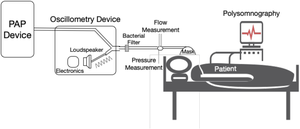
High frequency-low amplitude oscillometry: Continuous unobtrusive monitoring of respiratory function on PAP machines
Hamed Hanafi Alamdari, Luke Hacquebard, Stephen Driscoll, Kamal El-Sankary, David C. Roach, Robin LeBlanc, Scott C. Lowe, Sageev Oore, Thomas Penzel, Ingo Fietze, Michael Schmidt, Debra Morrison
IEEE Transactions on Biomedical Engineering 69 (7), 2202–2211, 2021
Shows that high-frequency, low-amplitude airflow oscillations added to PAP machines can continuously and unobtrusively track upper-airway patency, distinguishing obstructive from central apnea and hypopnea events.
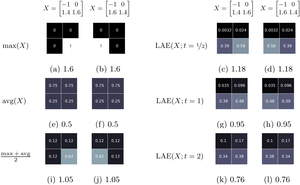
LogAvgExp Provides a Principled and Performant Global Pooling Operator
Scott C. Lowe, Thomas Trappenberg, Sageev Oore
arXiv preprint arXiv:2111.01742 preprint
LogAvgExp is a theoretically grounded global pooling operator for neural networks whose single temperature parameter smoothly tunes behaviour between averaging and taking the maximum, improving computer vision performance.
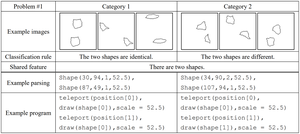
Program synthesis performance constrained by non-linear spatial relations in synthetic visual reasoning test
Lu Yihe, Scott C. Lowe, Penelope A. Lewis, Mark C.W. van Rossum
arXiv preprint arXiv:1911.07721 preprint
Shows that a program-synthesis classifier can solve abstract visual reasoning puzzles but fails on tasks needing shape-distance comparisons, because such spatial relations scale poorly and stay hidden from its image parsings.
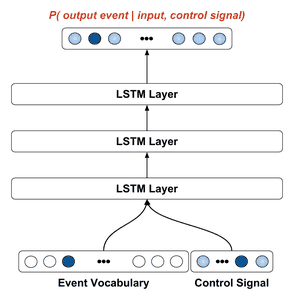
Exploring conditioning for generative music systems with human-interpretable controls
Nicholas Meade*, Nicholas Barreyre*, Scott C. Lowe, Sageev Oore
10th International Conference on Computational Creativity, 2019
Adds human-interpretable controls to a piano music generator, letting users steer output by composer style, historical era, note density, and other intuitive musical attributes.
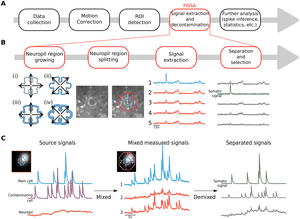
FISSA: A neuropil decontamination toolbox for calcium imaging signals
Sander W. Keemink*, Scott C. Lowe*, Janelle M.P. Pakan, Evelyn Dylda, Mark C.W. Van Rossum†, Nathalie L. Rochefort†
Scientific reports 8 (1), 3493, 2018
FISSA is a fast, low-memory Python toolbox that cleans calcium imaging signals by removing contamination from surrounding brain tissue, giving more accurate readings of individual neurons' activity.
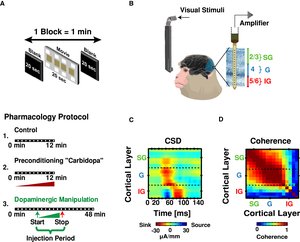
Dopamine is signaled by mid-frequency oscillations and boosts output layers visual information in visual cortex
Daniel Zaldivar, Jozien Goense, Scott C. Lowe, Nikos K. Logothetis, Stefano Panzeri
Current Biology 28 (2), 224–235. e5, 2018
Shows that in monkey visual cortex dopamine raises local field potential power specifically in a mid-frequency band and boosts visual information in the output layers that feed higher cortical areas.
Decoding information from neural populations in the visual cortex
Scott C. Lowe
The University of Edinburgh, 2017
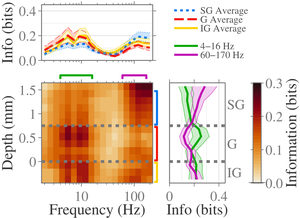
Uses information theory to decode monkey visual cortex activity, showing that training sharpens stimulus information in area V4 to match behaviour, while V1 oscillations encode distinct movie features across oscillation frequency and layer depth.
Behavioral-state modulation of inhibition is context-dependent and cell type specific in mouse visual cortex
Janelle M.P. Pakan, Scott C. Lowe, Evelyn Dylda, Sander W. Keemink, Stephen P. Currie, Christopher A. Coutts, Nathalie L. Rochefort
eLife 5, e14985, 2016
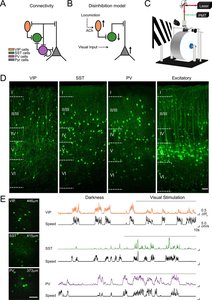
Shows that locomotion boosts several inhibitory neuron types in mouse visual cortex differently depending on whether the animal views stimuli or darkness, challenging the simple disinhibition model.
Shifts of gamma phase across primary visual cortical sites reflect dynamic stimulus-modulated information transfer
Michel Besserve, Scott C. Lowe, Nikos K. Logothetis, Bernhard Schölkopf, Stefano Panzeri
PLoS biology 13 (9), e1002257, 2015
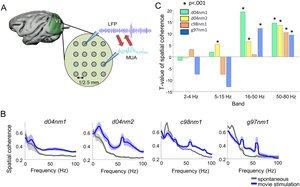
Shows that gamma-band brain waves in the monkey visual cortex travel across the tissue and dynamically steer the direction and strength of information flow between neuron groups as stimuli change.